
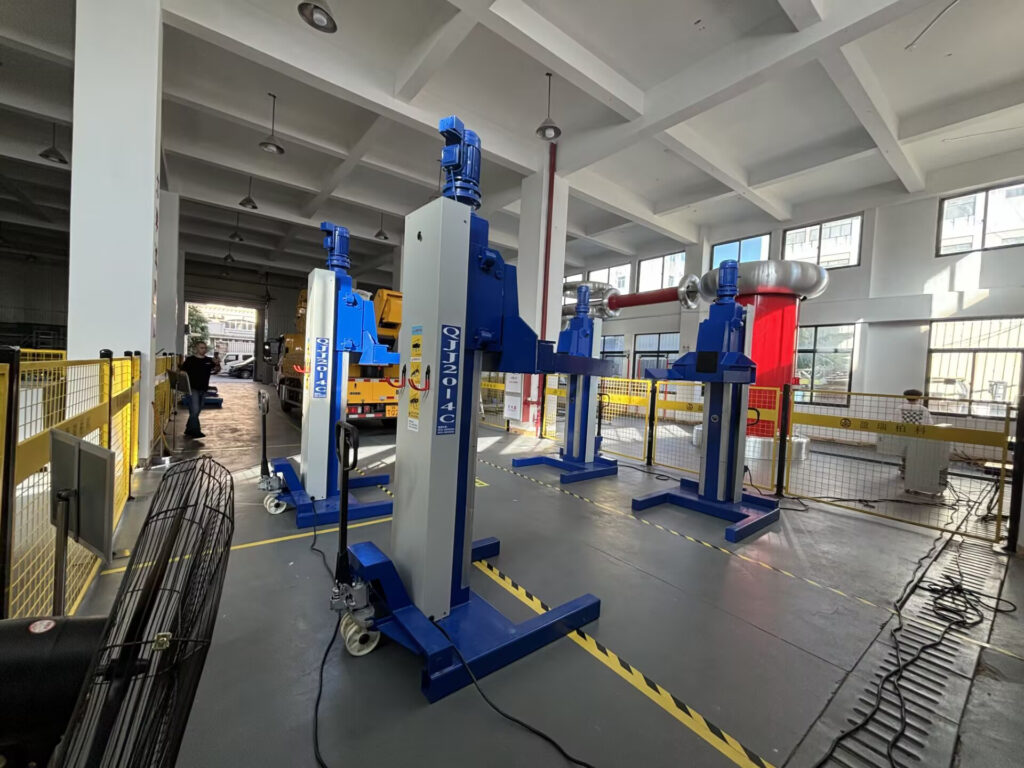
When selecting a column car lift for workshops, fleet maintenance, or industrial applications, one of the most important design differences to understand is the lifting mechanism. The two main types on the market are mechanical column lifts (screw-and-nut system) and hydraulic column lifts.
Although both are designed to lift vehicles safely, their working principles, reliability, and long-term performance differ significantly. This article focuses on product knowledge and practical use, comparing mechanical and hydraulic column lifts, and explains why mechanical column lifts offer clear advantages for professional and long-term use.
What Is a Mechanical Column Lift?
A mechanical column lift uses an electric motor to drive a precision screw and nut system. As the screw rotates, the nut moves vertically, lifting the vehicle in a controlled and synchronized manner. Each column operates independently but is electronically synchronized to ensure balanced lifting.
Because the load is mechanically supported by the screw-nut structure, the lift remains stable even when power is interrupted.
The Grandlink Mechanical Column Car Lift adopts this proven design, widely used in industrial lifting and heavy-duty applications.
What Is a Hydraulic Column Lift?
A hydraulic column lift relies on hydraulic cylinders, pumps, hoses, and valves to generate lifting force. Pressure from hydraulic oil raises the columns, while lowering is controlled by hydraulic valves.
This design is common in many traditional vehicle lifts, but it introduces additional components that are sensitive to wear, leakage, and environmental conditions.
Mechanical vs Hydraulic Column Lift: Key Differences
1. Safety and Load Holding Capability
Mechanical Column Lift Advantages:
- Load is held mechanically by the screw-nut system
- No risk of sudden descent due to hydraulic pressure loss
- Stable position even during power failure
Hydraulic Column Lift Limitations:
- Load depends on hydraulic pressure and valve integrity
- Potential risk of oil leakage or seal failure over time
- Requires additional safety locks to prevent unintended lowering
Conclusion: Mechanical column lifts provide inherent load-holding safety.
2. Precision and Synchronization
- Mechanical systems offer precise, controlled movement with minimal drift
- Hydraulic systems may experience slight speed variations due to pressure fluctuation, oil temperature, or air in the system
For column lifts used in alignment work or heavy vehicle maintenance, precision and repeatability are critical.
3. Reliability and Durability
Mechanical Column Lifts:
- Fewer wear-sensitive components
- No hydraulic oil, hoses, or seals
- Consistent performance in hot, cold, or dusty environments
Hydraulic Column Lifts:
- Hydraulic oil degradation over time
- Seals and hoses subject to aging and leakage
- Performance affected by temperature changes
4. Maintenance and Operating Cost
| Aspect | Mechanical Column Lift | Hydraulic Column Lift |
|---|---|---|
| Routine Maintenance | Low | Moderate to High |
| Consumables | Minimal | Hydraulic oil, seals |
| Leakage Risk | None | Present |
| Long-Term Cost | Lower | Higher |
From a long-term operational perspective, mechanical column lifts typically result in lower total maintenance cost.
5. Environmental and Workplace Cleanliness
Mechanical column lifts operate without hydraulic oil, which means:
- No oil leaks on workshop floors
- Cleaner working environment
- Better suitability for indoor, clean, or environmentally regulated facilities
This is an increasingly important factor for modern workshops and fleet operators.
Why Choose a Mechanical Column Lift from Grandlink?
Grandlink designs its column car lifts using a mechanical screw-and-nut lifting system to meet professional demands.
Key advantages include:
- Inherent mechanical safety
- High lifting precision and stability
- Reduced maintenance requirements
- Long service life under frequent use
Learn more about the product here: Grandlink Mechanical Column Car Lift
Application Scenarios
Mechanical column lifts are particularly suitable for:
- Heavy vehicle and truck maintenance
- Bus and fleet service centers
- Industrial workshops
- Facilities requiring high safety and clean operation
Conclusion
When comparing mechanical column lifts and hydraulic column lifts, the mechanical screw-driven design stands out for its safety, reliability, precision, and low maintenance requirements.
For professional users seeking a dependable column car lift for long-term operation, mechanical column lifts represent a robust and future-proof solution.
